
MULTIpedia #10 - CATS DON’T QUIT
What scenarios did shipyards present in Cannes to face market uncertainties.


CATS DON’T QUIT
Last April, at the International Multihull Show in La Grande Motte, tension was palpable among shipyards and concern about the economic outlook was widely shared. Even though the multihull sector was less affected than others, with order books that, in some shipyards, allowed them to ‘see what would happen’, the end of the post-Covid euphoria was objectively a reality. Five months later, after a summer that was not as bad as feared, smiles remained timid but the atmosphere was less heavy. All the brands had a strategy to showcase, including a flood of new products.
At Fountaine Pajot, the communication focused on five new products for the year. In reality, the FP-41 and FP-44 have already been released. The FP-48, which replaces the Tanna 47, is expected in spring 2026, while the FP-55, which fills a gap in the range, should be presented in Cannes in September 2026, as should the FP Y70S (Y for Yacht and S for Sail, as there is a motor version of the larger models that will be called the FP-Y70 Power). Romain Motteau admits to having asked a lot of his teams and partners, as confirmed by Berret Racoupeau Yacht Design, the agency responsible for designing all these new models. The Managing Director of Fountaine Pajot tells us: “We didn't want to have any regrets, which is why we embarked on a major investment policy, both in new boats and in production capacity. We postponed these investments during the period of euphoria, which we were convinced would not last, and we are very happy with this timing, with lots of new boats at the best prices. We are also pleased to have integrated our distribution more fully in order to get good feedback from the market. In the United States, the situation ‘is not stopping buyers, because sailing catamarans are not necessarily imported into the US”. [Editor's note: in May 2023, the Fountaine Pajot group acquired a majority stake in its main American distributor, Atlantic Cruising Yachts (ACY), based in Annapolis, Maryland, but also in St. Petersburg (Florida), Fort Lauderdale (Florida)...] In terms of economic strategy, Romain Motteau affirms that ‘after a period of inflation that also led to improved margins in the yachting industry,’ they want to use their new range to offer more for less, with slightly larger, slightly more spacious catamarans, with a little more equipment, particularly on deck... “As we have been doing for 15 years now, we are trying to position ourselves as a slightly more premium brand, with a mix of performance, comfort and volume that suits us well in the face of competition, in order to respond to our two markets, owners and charterers”. Given this positioning, the charter market accounts for only 20% of their turnover. The last point discussed with the CEO of the group, which also includes Dufour, was the abandonment of the individual names of each catamaran, which had prevailed for more than 30 years (with the first Louisiane 37 in 1983), in favor of the more generic FP followed by the length in feet. "The process was not easy, but it was becoming too complicated with a much wider product range and lots of names to manage and renew. And then there is also a mode of communication that has evolved considerably with digital technology taking up more and more space, especially in a year when there are a lot of launches, with a geographical mix that has also changed a lot. We made this painful but rational choice."
Did you say normality?
The next day, we met Gianguido Girotti, CEO of the Beneteau Group, after a press conference where his President and accomplice, Bruno Thivoyon, admitted that after five years in his position, "I still don't know what a normal year in the boating industry is!” In this difficult context, Gianguido Girotti confided that the group's good fortune lies in having a truly global distribution network, covering every place where people can sail, even though the United States still accounts for 30% of the group's turnover. He confirms what Yann Masselot told us in La Grande Motte, that the 15% import tax currently in force is shared 50/50 between the group and the distributors "to avoid passing on higher prices to our customers. We have to live with political instability, and it is our responsibility to constantly adapt.” With a 30-year presence in Asia, to the point where multihulls are known as ’Lagoon" in Chinese, the charter market is growing, particularly in Thailand, and Mr. Girotti believes that Turkey still has great growth potential. Multihull sailing “has significant weight in terms of turnover, impact and ambition” in this strategy of conquest, with the decision taken a few years ago to expand the offering with a new brand, Excess, and to extend the Lagoon range. The new models for 2025 perfectly illustrate this direction with the arrival of both the smallest (Lagoon 38) and the largest (Lagoon Eighty 2) models in the range. Although he does not wish to disclose figures, he confirms that Lagoon is the group's top-selling brand. In Cannes, Lagoon announced, in a minor publicity stunt with its main competitor, six new models unveiled over the last 12 months, five sailing catamarans and one power (Eighty 3), including the Lagoon 46 and 51 ‘Iconic’.
Alongside this impressive armada of eight Lagoon on display, Excess continues to play its own tune, in start-up mode. Just five years after its launch, the brand may have found its reference model in the Excess 13, but it didn't wait for this to happen to already have 500 boats produced (by the end of 2025) and claim the leading position in the private owner market (20 to 25% of its turnover for chartering) over the last 18 months in France and the United Kingdom. The next challenges for the ‘orange’ brand are the roll-out of the hybrid engine installed on the Excess 11 at a reasonable price, the launch of Excess Share, an original shared use programme created in partnership with Wiziboat, and the development of a future model, about which nothing is yet known, but which could be around 15m/50ft, now that the 11, 13 and 14m categories are occupied with models that perfectly match the brand's DNA.
THE 50’ SPOT
Within the Catana Group, the news is all about Bali. Although in 11 years the brand, created from scratch, has produced more than 1,500 boats, with 15 models launched, the time has clearly come for rationalisation with the launch of the Bali 5.2. Indeed, the latter replaces two successful models: the 5.4 released in 2019 and the 4.8 launched in 2020, both of which have been produced around 200 units each. Produced in the Marans factory, its base price (€953,000 excluding VAT) is announced as lower than the 5.4, while drawing inspiration from the design and finish of the Bali 5.8, which had shown a nice evolution in this direction. Faced with the uncertainty that has been weighing on the market for several months, Boris Compagnon, the group's marketing and sales director, has come up with his motto: “Today is the new norm! In a difficult market, it's always good to come up with a new model, especially in the 50-foot sweet spot, which appeals to private owners, rental companies and even crewed charter operators.” The layout can accommodate up to 6 cabins/bathrooms + crew, or 16 people on board, even if this is not the ideal format, but it cannot be said that Bali has not done everything possible to satisfy the 50% of professionals who make up its demand.
At Leopard, new products are not unveiled months in advance, but in situ on the first model in the series. This was also the case this year in Cannes, where the brand new Leopard 52 was announced only the day before the show where it was presented. Introduced by Franck Bauguil, its vice-president, as the 5th generation since designed by Simonis Voogdt, with whom they have been working since 1996. In a “highly segmented” market, the new entrant is targeting exactly the same market as the Bali 5.2. We should rather say THE same markets, since no less than 10 layout versions are possible, between the essential three-cabin owner's version and the possibility of accommodating up to 10 guests and three crew members. She is announced at a standard price of €899,000 excluding VAT, or between €1.1 and €1.4 million excluding VAT fully equipped. Admittedly, the option for JOOOL hybrid propulsion can significantly increase the final bill, but it includes options that have become almost essential, such as lithium batteries, solar panels and even a generator.
LONGER, FASTER, NOT CHEAPER
There were no big announcements at Outremer Catamarans either. You had to study the panels on their stand to discover that, in addition to the future Outremer 48 unveiled in Cannes, a 55 and an Outremer 63, the brand's future flagship, are in the pipeline. The latter model seems to confirm the upward elasticity of the segment. And the announcement of the future Windelo 58 and 62 (Windelos always come in pairs) does nothing to contradict this. Remaining faithful to the Barreau-Neumann architectural duo from their early days, the two partners had the opportunity to work with the Stellantis Design Studio (formerly Peugeot). They focused particularly on the interior design, promising us almost real 360° visibility with a saloon featuring glass corners like the aft cabins. Christophe Barreau remains uncompromising about the DNA of his designs, so he assures us that although the new Windelo will be longer, they will not be heavier, with the 58 announced at less than 20 tonnes, which bodes well for excellent performance. The same promise has been made, but the evolution is more radical at Gunboat, with a model that is also larger. After adopting the flybridge on the 72, here is a model with a hardtop, the Fusion 80. But we will have to wait at least three years to see how it performs on the water. Also present this year, and for the first time, were the Kinetic 54 and the Comar C-65, which were not to be missed in Cannes. We will discuss them in more detail in a future issue of MULTIpedia. We will also analyse in detail the evolution of prices of prices among major brands. So, STAY TUNED!
SPOTTED
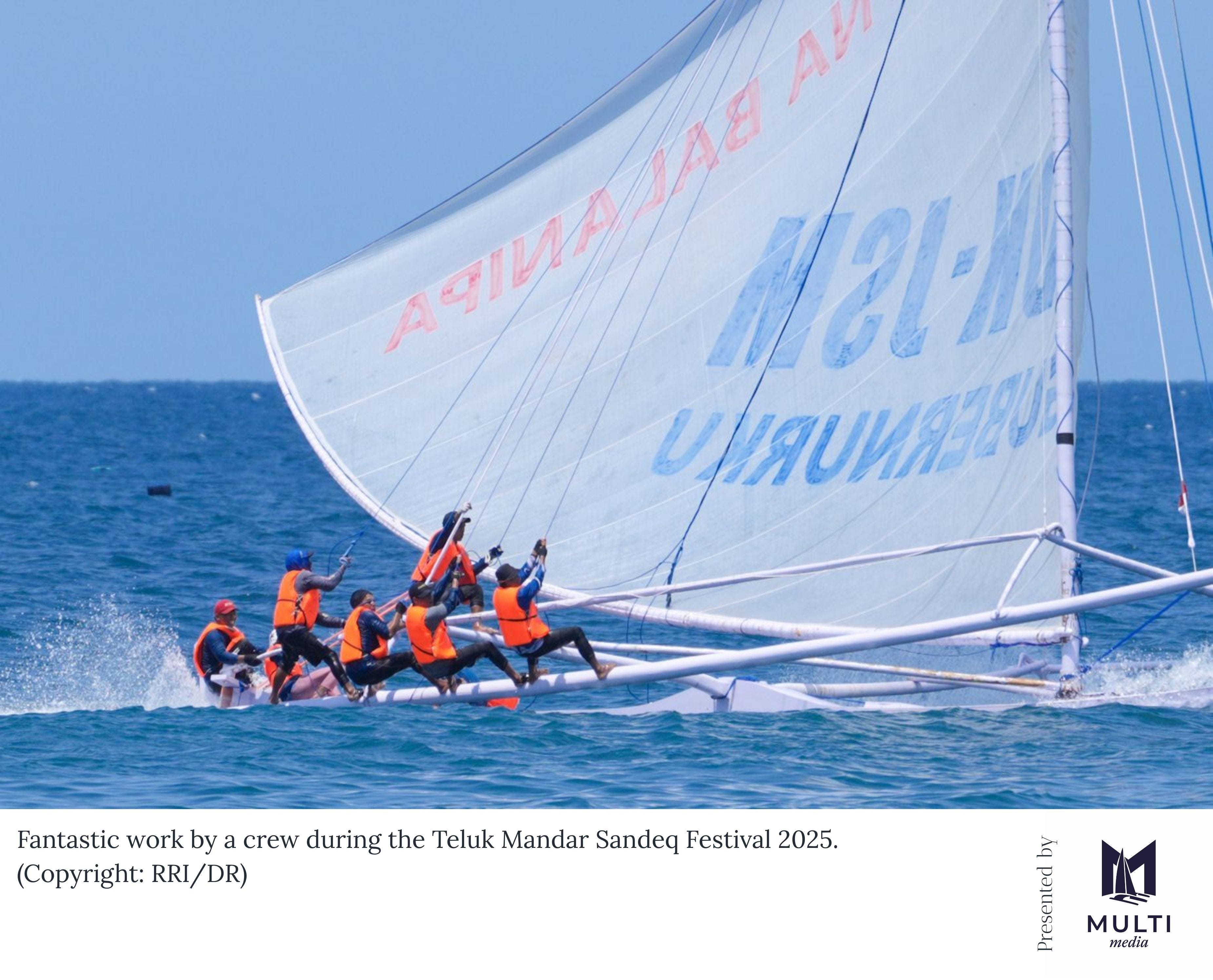
In Indonesia, outrigger canoes, the ancestors of our trimarans, have a history dating back thousands of years. In the province of West Sulawesi in Mandar country, they are called sandeq. It was Bintang Maha Putra who won the 2025 Teluk Mandar festival, the national championship for this speciality. Be sure to watch the short video unearthed by our colleagues at Multihull Scene and admire the finesse, purity, speed and balance of these original multihulls.
IN SHORT
CROSSING
60 crossings and very neatly 400 passengers ferried between Dover and Boulogne between April and August for Sailink. Most of the crossings under sail and in good time says Andrew Simons who promises to publish honest performance statistics in October at the end of this first season.
NOMINEES
The European Yacht of the Year award is one of the most prestigious, as it is decided, after testing the nominees, by a vote of journalists from the nautical press coming from 12 European countries. For the 2026 edition, the results of which will be announced next January, there will no longer be a dedicated multihull category, but five length categories. The list of nominees revealed by our German colleagues at Yacht magazine includes one trimaran and six catamarans: the Dragonfly 36, the Lagoon 38, the FP-41 from Fountaine Pajot, the Excess13, the Leopard 46, the Tortue 147, and the VAAN R5.
CONCEPT


Thanks to all the skills acquired through Ultims, we know that something is brewing in a shipyard in western France right now, but it's top secret. In the meantime, and in the same spirit, we found this magnificent 100' trimaran in our archives, designed almost 10 years ago (in 2016), but it hasn't aged a bit! We particularly love this AIRBENDER 100’ Japanese-inspired interior. The design team consists of the Salt & Water studio CEO, Svetlana Mojić, Joao Alexandre Pinto Ferreira from Portugal as the naval architect, and Coşkun Kocagöz is an industrial designer from Turkey.
LITTLE FLAGSHIP
With the Tricat shipyard having just launched its new 8.50m model, we understood that its new director, François-Xavier Tillier, had bigger ambitions for the future. This information has now been confirmed by the shipyard in a comment on the rendering unveiled by Paul-Emile François. This new 10m or so model will sit above the Tricat 30, expanding the range at the top end.
SURPRISE
To our knowledge, this is the first time that a manufacturer of power multihulls is going to sailing. Three sailing catamarans have been announced, since in addition to the Aquila 50, which is set to be unveiled as early as the Miami Boat Show in February 2026, a 44-foot and a 63-foot model are scheduled. This is something of a return to their roots for the Raas brothers, whose father Lex (see MULTIpedia #09), who has just retired, was behind the extraordinary development of the sailing catamaran during his time at The Moorings and Robertson & Caine before launching Aquila in 2012, which has since become the world leader in power multihulls. The sailing yachts will also be built at the Sino Eagle Yachts factory in Hangzhou, China. J&J Design has been chosen to handle the design. The roof combines profiled side windows and a vertical front that provides a forward cockpit. The first renderings show an interior that makes extensive use of white. The galley is located in the nacelle, and the layout, which offers four to six double cabins with as many bathrooms, indicates that the target market is both charter and private owners. One can guess, by studying these images carefully, direct access to the cabins both, in the aft cabins to the cockpit and in the forward cabins to the foredeck, which is more original, even if already seen on Privilège, for example.
ALUMINUM TOO
We have discussed at length (see MULTIpedia #07), particularly with SV Delos, the advantages of aluminium multihulls. We just learned that naval architect Pierre Delion has designed two new catamarans using this material. The French shipyard Ocea, a specialist in commuters based in Les Sables d'Olonne, is set to deliver its first sailing catamaran, a 65-foot catamaran named Cosmoledo, in early 2026. On the other side of the globe, in New Zealand, the Nahoa 55 is under construction, also designed by the same agency. “The Nahoa 55 was born from the hard-won lessons of 1.5 circumnavigations. With the hand of Pierre Delion, she is an aluminum expedition catamaran built to cross oceans fast and thrive in the most remote waters on earth” according to its promoters, Ben & Ashley from Sailing Nahoa.
HEMISPHERE
The sailing catamaran Hemisphere, until very recently the largest in the world, is up for sale. Launched in 2011, built by the renowned British shipyard Pedennis to plans by French naval architects VPLP and with interior design by Michael Leach, and refitted in 2023, this luxurious multihull, measuring 44.20m/145'ft in length and 15.24m/50ft in width, can accommodate up to 22 guests and 10 crew members. Available for charter from USD 260,000 per week, it is also being offered for sale by Burgess at a price of EUR 48,000,000. The problem is that it has now been surpassed by Artexplorer, also made of aluminum, at 47m/154ft.
TO THE MOON
A 50m / 164ft yacht emits the equivalent CO2 yearly of 39 trips to the moon by car (1,794 tons from cruising 900h per year) said last year in Monaco Julien THIEL, CEO at Deasyl SA, whose mission is to offer eco-friendly alternatives that improve conventional chemical processes. Whatever solutions his company proposes, the impact of a sailing multiyacht will remain almost insignificant in comparison. This year Monaco Yacht Show will take place from 24 to 27 September.
RACING
OPEN BUT…
The notice of race for the 2026 Route du Rhum has been published by organiser OC Sport Pen Duick and registration is now open. It reveals the number of entries allocated per category and says a lot about the health and influence of the different offshore racing classes, even though the organisation reserves the right to award an unlimited number of wild cards at its discretion. In the multihull category, there will be seven Ultims, which suggests that Actual Ultim 3 (replaced within the team by Actual Ultim 4, formerly Gitana 17) will have found an owner by then. The decision to limit the Ocean Fifty Class to a maximum of 10 trimarans seems to be paying off, as it has ten places for all its members (compared to 40 places for Class40 monohulls, even though 80 could be at the start... there are going to be some disappointed people). Finally, Vintage Multihulls (multihulls between 38 and 79 feet in length) are limited to 12 participants (compared to 17 in 2022). The new rules aim to encourage the return of Orma trimarans, legendary boats (launched before 2011) or sailors who have made history. Only eco-designed recent multihulls will be eligible. However, the eco-design criteria are likely to exclude some of the nine boats pre-registered to date. For boats built between 2011 and 2024, unless they are made of wood or plywood, their light displacement must be less than 8 tonnes. If you are interested, please note that the registration fee is €90,000 excluding VAT for an Ultim, €20,000 for an Ocean Fifty, and €10,000 for a Vintage Multi.
DELAYED
Every launch is a promise, and some are worth waiting for. The new Maxi Edmond de Rothschild, Gitana 18, will remain in the shipyard for a few more weeks to ensure that every detail is completed to the highest standards. Initially scheduled for launch in the autumn to compete in the Transat Café l'Or as its inaugural race, its launch is now scheduled for early December.
INTERNATIONAL CREW
The giant trimaran The Famous Project CIC is set to set sail by the end of the year in an attempt to break the Jules Verne Trophy record, which rewards the fastest circumnavigation in all categories. It would be the first non-stop, unassisted circumnavigation of the globe by an all-female crew. The challenge is enormous, as the Jules Verne Trophy is one of the highest peaks in offshore racing. Since its creation in 1993, there have been 33 attempts, but only nine boats have managed to complete the journey within the time limit.
The challenge will be tackled on a boat that has already made history. Built in 2006 to VPLP specifications, the Maxi Trimaran IDEC SPORT has held the Jules Verne Trophy since 2017 with Francis Joyon and his crew, who completed a round-the-world trip in 40 days, 23 hours, 30 minutes and 30 seconds.
To take up the challenge, skipper Alexia Barrier has assembled an international and multidisciplinary crew, with six sailors from the Olympic Games, IMOCA and The Ocean Race: Dee Caffari (Great Britain), Annemieke Bes (Netherlands), Rebecca Gmuer (Switzerland/New Zealand), Deborah Blair (Great Britain), Molly Lapointe (American-Italian), and Tamara Echegoyen (Spain).
MEDIA CENTRE
Guirec and Inoxtag, the film: 10 days to cross the Atlantic Ocean! (Teaser FR)
After sailing with his hen Monique, then completing a round trip across the Atlantic by rowing boat, and finally finishing the last Vendée Globe in Imoca, Guirec Soudée will set out alone next November on the most challenging round-the-world voyage in maritime history, sailing West against the winds and currents. During a training session on his giant trimaran, which involved crossing the Atlantic from Lorient to Martinique, he invited YouTuber Inoxtag to discover, after conquering Everest, his world. Throughout the journey, Guirec introduced his guest to a world that was completely unknown to him and initiated him into the rhythm of life on the open ocean. Eager to learn, the YouTuber gained a great deal of knowledge from his elder companion. The two adventurers, who were both friendly and playful, discovered that they had many character traits in common and learned a lot from each other during the crossing. The result will be available to view this Saturday, 20 September, at 2.30 pm (CET) on Inoxtag's YouTube channel.
Hand Building a 41ft Wooden Catamaran by The Floating Stories Lab
FSL, a non-profit association, is creating a research and storytelling vessel, a 41ft Polynesian-inspired wooden catamaran that will serve as a collaborative base for research, storytelling, and community engagement. This is only the first episode, covering preparations for the construction site in Brittany in western France, but we are eager to follow the progress of this unique building project.