
MULTIpedia #07 - 2025.07.01

NOT THE USUAL CATAMARAN
Some news may reveal a fundamental trend. For example, the fact that the owners of SV Delos, who have sailed almost 90,000 nautical miles aboard their Amel, a 50-foot polyester monohull, are switching to a 53-foot aluminum catamaran in front of their 920,000 YouTube channel subscribers cannot be insignificant. So, we asked them about their choice, as well as Vaan Yachts and Garcia Yachts, who both offer aluminum catamarans in these sizes.
A quick reminder of aluminum in yachting history: in the 60s, it first won over ocean-going monohulls, which already appreciated its lightness, strength and resistance to corrosion if everything was well designed, well-made and well maintained, particularly the electrical system. In the 70s, a number of French boat builders made it their speciality: Alubat with the Ovni, Garcia (Maracuja, Passoa...) and Meta. Why did they do this? Because aluminum, and in particular marine alloys such as 5083 or 5086, can withstand significant deformation before breaking, which is invaluable in the event hitting the ground, hitting a log, beaching voluntarily or not, or parking in somewhat rustic environments such as a fishing or commercial harbor. The tensile strength of aluminum 5083 varies between 270 and 350 MPa, compared with 80 to 150 MPa for a glass-polyester laminate. Similarly, its elongation before break varies from 10 to 20%, compared with 1.5 to 3% for polyester. Aluminum is also relatively light. Its density averages 2.7 g/cm³, slightly heavier than composite (1.5 to 2) but only 1/3 that of steel (7.85). This keeps the total displacement under control, while maintaining a rigid and solid structure. Before the advent of composites, and especially carbon, many racing yachts were built in aluminum, including some multihulls. In 1968, Eric Tabarly had Pen-Duick IV built, the first aluminum trimaran to perform in history, even though it was tragically lost with Alain Colas aboard during the first Route du Rhum in 1978. This did not stop Marc Pajot from having the Elf Aquitaine catamaran built in this material and winning the second edition in 1982.
PIONEERS
Its qualities are often summed up by saying that, for the same weight, an aluminum hull can absorb up to 7 times more energy than a polyester laminate without breaking. But aluminum is also appreciated by serious cruisers for its rusticity, because it forms a natural oxide layer, which may be a little dull, but is protective. So there's no need for paint or varnish (apart from special antifouling for aluminum hulls under the waterline, of course, and covering for the more aesthetically minded). What's more, in the event of an impact or crack, aluminum can be easily repaired just about anywhere in the world. The French singer Antoine, through his books and DVDs, has made Banana Split popular, the 12.50 m / 41 ft catamaran aboard which he has been travelling the world since 1989. Built in Strongall (thick aluminum without structure) by Prometa, it gave birth to several Banana, the last of which was built by Garcia in 2013. At the same time, Alubat and Allures both presented attractive projects for aluminum catamarans in the 47-foot range, but none of them has yet been completed. In 2019, however, Garcia is presenting the first Explocat 52, a two-hull variation of their range of exploration monohulls. Designed by naval architects Pierre Delion and Darnet Design, it will be presented to the public for the first time at the Cannes Yachting Festival 2021.
DELOS TURN
Although they opted for a specific design by De Villiers Marine Design New Zealand and custom construction, Brian and Karin, who are currently having their Delos 2.0 aluminum catamaran built near Brisbane, explain their choice: "We are liveaboard sailors, and the first thing is that we really hate rolling, downwind, at anchorage. Plus (on a catamaran) you have a little bit more living space, you can get a little bit better performance, but the main dragging factor for us is change. It's good to try new things, to learn so you don't stagnate yourself as a sailor. For a long time, we thought what the concept of our next boat would be. It originally started with a larger aluminum 60' swing keel monohull, fully insulated, capable of going to higher latitude, more an expedition style boat. But I went to Annapolis and I saw the first boat that excited me for a long time and it was a 62' cat rig aluminum catamaran designed in New-Zealand, with a forward cockpit like some of the Chris White design, the Atlantic Series, and I thought it was a very interesting concept. I was a kind of combination of two worlds. We really wanted to stick to a 53' or 16m range, I think it's a pretty good size for a boat, not getting too large. So I talked to the designer who was actually designing a smaller version. We didn't want a fancy boat, we are not dockside people, we didn't really care about being too shiny, the boat should be very useful, and capable of going everywhere you want to sail and very low maintenance. We worked with the designer to incorporate features that as sailors we feel as necessary. Our requirements are specifically long range, long distance off the grid, sailing for a long time with very robust systems, something that you can fix yourselves. I felt very comfortable that we could design all the systems, the propulsion and come up with a good workable sail plan and all that, but having a team of talented people to do the metal work and the fabrication of the boat was key. We met Dan, who is a boiler maker and lives in Australia. We flew to meet and we were blown away by his skills. It is something that's learnt over a life time of experience. It's a very labor-intensive process, but aluminum is just a fantastic material, especially when you start to look at boats over 50', the structure and the weight to size ratio really starts to make sense. It's very strong, very durable, very light when you look at the impact resistance of aluminum, it deforms rather than fractures. We like the look as well".


FURTHER
The program for this type of catamaran? "I would love to do a giant Pacific loop says Brian. I would love to go from Australia up to Asia, visit Japan and then up to Alaska, the Pacific North-West. This is the ideal boat to go to Svalbard, do the North-West passage or go to Patagonia, Tierra del Fuego or Chile". Olivier Devinck at Garcia confirms: "To date, there are ten boats sailing around the world. Number 2 is planning to do the North-West Passage and number 1 has already been to Iceland. The Explocat is for people who want to sail a catamaran but who want a boat that can get away from the classic route, Mediterranean-Antilles-Polynesia, which can go higher or lower on the globe. A boat that is safe, insulated, heated with all the comforts and safety. Even in a swell, with 25-30 knots, in heavy seas, between the rigidity of the structure and the insulation, when you get inside the boat, there are two rooms, two atmospheres", because aluminum means insulation to avoid condensation. The Explocat 52 is therefore fully insulated above the waterline, hull and nacelle, with 36mm of foam, which can be doubled (52mm) as an option if the owner plans to winter in the cold, for example. The Delos 2.0 will also be "fully insulated, a combination of spray foam and closed cell fire resistant polyethylene foam. It's good for both, thermal and acoustic insulation."


THE RIGHT BALANCE?
All praise the rigidity provided by aluminum. Olivier Devinck explains: "On a composite catamaran, to make the two floats and the nacelle rigid, you need a lot of reinforcement. The aluminum structure, on the other hand, is self-structuring, with much less deformation. When Pete Goss sailed the Explocat in 25 knots upwind, he pointed out to us that the leeward shroud didn't move at all. And in terms of weight, the aluminum catamaran is midway between light catamarans with daggerboards and comfort catamarans with lots of equipment on board for a holiday or charter program. The Explocat is exactly in between the two in terms of comfort and performance. We've had Explocat owners averaging 10.5 knots for 36 hours with their families, in total comfort, because the boat doesn't bang and is soundproofed. We won't reach very high-top speeds, but on a long-distance cruising program it's more interesting to be able to average high speeds without realizing it, whether the conditions are good or bad". To optimise weight and strength, the Explocat 52 is made from 5 mm thick aluminium sheets, except for the bottoms, which are 8 mm thick.
COCKPIT STYLES
The advantage of aluminum catamarans produced in small series, without moulds, is that they can be quite easily customized. So, while the first Explocat 52 was built with two helm stations at the stern, all the others have been delivered with "a very heavy conditions deck layout, meaning that it's organized so that the helmsman can steer 'in slippers' in the lower section thanks to the pendulum helm", Marc d'Arbigny, Garcia's CEO, tells us. Vaan has a slightly different philosophy, as its founder Igo Kluin tells us: "The essence of Vaan is sailing, style and sustainability. So sailing is important, that's why we have a low boom and the helm stations at the back. Catamarans are fantastic for cruising, for partying and lounging of course, but it's also a sailboat and for us it's a sailboat first". Brian and Karin have taken a radically different choice with a forward cockpit: "Will it be wet? Yes, sometimes if you're beating upwind into heavy weather, it will probably be wet but if you're looking at long distance cruising, 80%+ of our time is spent downwind or around the beam or behind the beam, and in those cases, we will be more protected because we'll have the boat behind us. We opted to put our helm inside as we did some sailing up North to Svalbard, 80° North, and up into Maine in Canada in very poor and cold weather, also bad weather in the tropics. And there was a lot of times where I wished my helm was more protected, out of the elements, out of the sun, out of the weather."


NO GREEN WASHING
But the most recent argument in favor of aluminum is its ecological qualities. Of course, manufacturers are highlighting the fact that it is a durable material and much easier to recycle than composite. Garcia Yachts also claims that "85% of the aluminum alloy we use is of recycled origin". Igor Kluin at Vaan Yachts goes so far as to specify the origin of the 70% recycled aluminum used: "the hull is 70% post-consumer scrap from window frames, license plates, traffic signs. The reason why I name them is because if you cut a plate of aluminum for the boat, you have some scrap. That is not post-consumer scrap, that's still new material. It's all about really post-consumption, it has been used, it's a very important distinction, because aluminum is sometimes qualified as recycled as well but it's really still virgin material. With our partner and supplier Hydro they create that 5083 marine type aluminum but the energy to produce it is 95% less" than classic aluminum. "In terms of sustainability the big number is kilograms of CO2 emissions per kilogram of aluminum. With Hydro, we are now developing an aluminum that is less than 2kg of CO2 per each kilogram of aluminum, this is seven time lower than the average, so those are real tangible numbers" he concludes.
So, while aluminum may not be the future of the catamaran, at least for cost reasons, the niche market of the exploration or custom-built multihull has a radiant future. Lightness, solidity, rigidity and ecology are the perfect answer to the demands of our time and of all those who don't want a boat like the others, or to go where all the others go. Behind Garcia, who has taken the lead in this market with 21 boats ordered, Vaan is playing the card of a unique minimalist style that leaves no one indifferent. As for S/V Delos 2.0, it is currently a one-off prototype, but others could follow these navigators and influencers of the third millennium. In the meantime, hull fabrication is done and seatrials are schedule for the first half of next year. “We are definitely a year from completion” concluded Brian enthusiastically live from the original S/V Delos en route to Australia from Fiji.
S/V Delos 53': 16m/53' - 7.70m/25'7 -16.3t/33973lbs - 154.5sqm - Price: undisclosed
Explocat 52: 16.95m/55’ - 8.20m/26’9 - 18.6t/41000lbs - 170sqm - Price: from €1.9 Mo
Vaan R5: 14.94M/494 - 7.99M/234 - 17t/34478lbs - 125sqm - Price: from € 1.5 Mo

SPOTTED
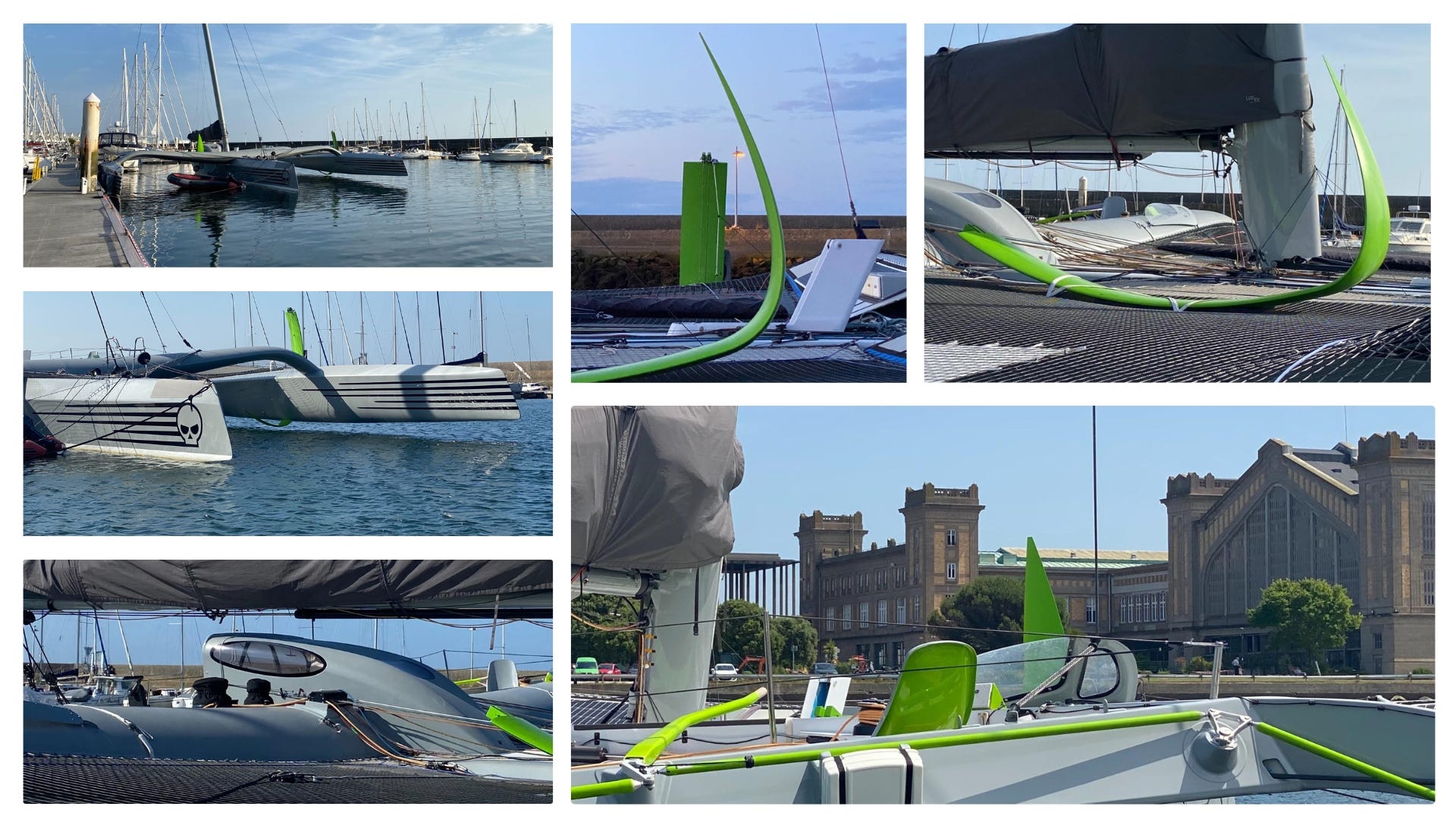
Erik Maris' MOD70 trimaran Zoulou who claimed Line Honours in 2023 in her category, is already back in Cherbourg-en-Cotentin to prepare for the next Rolex Fastnet Race. It is one of 21 competitors in the MOCRA multihull class, the three Ultims (SVR-Lazartigue, first to complete the 695 NM course two years ago in a time of 1 day, 8 hours, 38 minutes and 27 seconds, Sodebo, and Banque Populaire), and the eight Ocean Fifties that have added this exceptional centenary edition to their annual calendar. A total of 473 boats will set sail on Saturday, July 26, from Cowes on the Isle of Wight (UK), arriving in Cherbourg-en-Cotentin (France) between the evening of the 27th for the first multihulls and Friday, August 1, for the last monohulls.
IN SHORT
NEW 48’
The NEEL Trimarans shipyard has announced the launch of its next 48-foot model, the NEEL 48. Still designed by Marc Lombard Yacht Design Group, it has benefited from the expertise of Yannick Bestaven, winner of the 2020 Vendée Globe, particularly for the deck plan. The shipyard also reports that it has built more than 200 trimarans of all models since its creation in 2010.
DJ
According to French magazine Voiles & Voiliers, DJ Guts just started a 24 dates new tour between Normandy and the French-Spanish border. It’s called “Ocean Tour,” as the artist decided to travel by catamaran, a TS 42 built by Marsaudon Composites, and perform at each stop along the way.
VINTAGE
Eric Loizeau, a legendary figure in French ocean racing (Whitbread 77 on Pen Duick 3, Gauloise trimaran, Roger & Gallet catamaran, etc.) and mountaineer (Everest in 2003), has chartered Florence Arthaud's former trimaran Pierre 1er. He aims to take part in the 2026 Route du Rhum, 36 years after Flo's victory in the legendary 1990 solo transatlantic race on this very same boat.
DRAGONS FLY
The Round the Island Race attracted 18 multihulls this year, including a MOD70, Francis Joyon 60’ ORMA trimaran and 6 Dragonfly trimarans. At the same time, Xavier Bouin couldn't believe his eyes when he finished third in the 2025 Armen Race in the Multi 2000 class, with his children as crew members on his Dragonfly 40. Just starting on the same line as Armel le Cléac'h, Francis Joyon, and Marc Guillemot was a dream come true.
2026
The 2026 SailGP calendar is already available. 11 months between Perth (Australia) in January and the Grand Final in Abu Dhabi in November, 12 venues in total including Portsmouth (UK) in July, Saint-Tropez (France) in September, and a third event in Europe whose location has not yet been announced.
SERIOUSLY FOR SALE
The market is tight, but manufacturers are competing with commercial offers to keep customers interested. The Moorings is offering a €250,000 discount on the latest Moorings 5000 models available for charter in the British Virgin Islands. Even more original, Bali is offering you the chance to rent the catamaran of your choice and get a refund on the week's rental if you confirm your purchase at the end of the week.
MARKET
Nicolas Gardies, General Manager at Fountaine Pajot was a guest at the Portzamparc Forum (in French) on June 18. Excerpts: "If we are managing to do reasonably well in a more complicated nautical market, it is thanks to our ability to introduce new products. This is a year of major investment, in our models of course, but also in our factories. (...) We are in a cyclical business, and we are facing a second year of low levels as the market adjusts. Eight to nine out of ten boats are sold outside France. Turnover in 2024-2025 will be slightly down on last year, with a shift towards larger, better equipped and therefore more expensive boats. 2025-2026 will see many new products and will be a year of transition between two generations of boats." At the end of the first half of the fiscal year ending August, sales recorded a limited decline of 5.3% to €156.2 million (including Dufour Yachts). Despite the slowdown in activity, the manufacturer is maintaining its investment plan of almost €19 million through 2028. The manufacturer is keen to offer its customers electric motors, through its subsidiary Alternatives Energies. This option represents a price increase of around 15% on orders. It currently accounts for 10% of sales.
MARKET TOO
Euronext, the main stock exchange in the eurozone, has removed the Beneteau Group (Lagoon, Excess, Prestige, etc.) from the SBF120 index of the Paris Stock Exchange. Often cited as a benchmark, the SBF includes 120 of France's most influential companies, some of which are also listed on the top CAC 40.
In March 2025, the Beneteau group published its accounts for 2024, which were marked by:
- 29.4% drop in turnover to €1.03 billion
- reduced operating margin
- pessimistic forecast for 2025, with an expected drop in demand of 5 to 10% and massive destocking (€50 to 100 million), mainly in the first half of the year.
This deterioration led to a sharp drop in the share price (–10% on March 21), and the Euronext Scientific Index Committee removed the Bénéteau group from the SBF 120 to maintain the index's representativeness and robustness.
MEDIA CENTRE
PB72, a semi-foiling offshore machine / Seahorse Magazine (EN)
Ferdinand van West, project lead designer at Morrelli & Melvin takes us through the naval architecture of the PB72, a 72ft semi-foiling performance catamaran. “Traditional curved daggerboards like those we used on earlier performance catamarans provide both lift and lateral resistance – but by combining those forces into a single element, you sacrifice precision and control. With the PB72 we opted to separate the tasks: straight high-aspect daggerboards handle leeway resistance; T-rudder foils with elevators manage pitch and directional stability; and the righting moment foils (RMFoils) generate vertical lift and massive righting moment – up to 180 per cent more – allowing the yacht to ride higher and faster while staying firmly under control. This setup allows the PB72 to operate in a semi-foiling mode, optimized for 70–90 per cent lift. Unlike the full foilers seen in the America’s Cup, where yachts fly completely free of the water, we deliberately chose a configuration that retains some hull contact to maximise stability and control.” Full article HERE. This catamaran, which should be capable of reaching more than 30 knots with a level of comfort unprecedented at such speeds, is currently being completed at the Persico shipyard in La Spezia and is expected to be launched very soon.
Triple amputee completes solo, non-stop and unsupported Pacific voyage / PBO (EN)
Craig Wood (33) has achieved his goal of becoming the world’s first triple amputee to sail solo, non-stop, and unassisted across the Pacific Ocean. He sailed 7,506 miles in 90 days aboard Sirius II, a 41ft Galileo catamaran in… aluminum! Aged 18, Wood lost both legs and his left hand in Helmand Province, Afghanistan, on 30 July, 2009. “Years later, I found profound purpose back on the water, reigniting a passion for sailing my dad taught me. What began as rehab has become my way of life.” Wood is the world’s first triple amputee to achieve Royal Yachting Association (RYA) Yachtmaster status.
The history of Lagoon catamarans by Bruno Belmont / Voile & Moteur (FR)
In a podcast dedicated to Bruno Belmont, our colleagues at Voile & Moteur look back on 40 years of the Lagoon shipyard with one of its founders. Among other things, we learn that on the new Lagoon 38, the prismatic coefficient is now 0.52 compared to 0.48 on the legendary Lagoon 380. The prismatic coefficient (Cp) is a figure that describes the general shape of the hull below the waterline. For information, the prismatic coefficient compares the actual volume of a hull to that of a rectangular prism of the same length and beam (the largest cross-section of the hull). A low Cp (e.g. 0.48) indicates a narrow hull at the ends, with tapered shapes and volume concentrated in the middle. A higher Cp (e.g. 0.52) indicates that the hull has more volume at the ends. Going from 0.48 to 0.52 means that the hull is better suited to fast sailing over long distances, at the cost of slightly higher resistance at low speeds.
10 YEARS
It’s been 10 years since Laurent Bourgnon went missing at sea on June 24, 2015, while he was diving deep into an atoll's entrance channel in the Tuamotu Archipelago. This issue of MULTIpedia is dedicated to him, who inspired so much passion and vocations for multihulls.
Over the past four weeks, 3,136 of you have read MULTIpedia. Thank you very much, and feel free to share with your friends, colleagues, customers, or suppliers.
If this email has been forwarded to you, you can subscribe for free to receive our new articles directly.
Got some info, a question, a comment?
It’s summertime, next issue of MULTI.pedia will be sent on will be sent on 29 July