
MULTIpedia #14 - THINK DIFFERENT!
No #13, I’m not superstitious, but still...


To establish themselves over the last forty years as the leading sailing segment within the marine industry, multihull manufacturers have certainly not lacked innovative drive. Faced with a global crisis in demand, they are once again demonstrating resilience and imagination. MULTI.pedia spoke with Maya Gautier (Sales & Marketing Director) about the future Nautitech 41S, which aims to be as different in substance as it is in form; naval architect Loïc Goepfer, who is offering Ipsum, a high-performance 45’ trimaran available as a kit; and Erwan Taulois, who is in charge of developing Vélite, the Fountaine Pajot group’s new brokerage subsidiary.


At the end of June, the Nautitech shipyard launched the brand-new 41 Type S, a catamaran designed to be more sustainable, just as versatile as ever and even more high-performance. In a segment heavily focused on liveability, Nautitech is replacing its 11-year-old 40 Open with this 41 Type S – ‘Sport’ for short. Beyond a development programme focused on minimising weight, Maya Gautier explains that the shipyard “has worked on the hull shapes with the architects at Lombard. Inspired by offshore racing, we’ve incorporated concave hull shapes into this catamaran, with the stern of the hull rising upwards. ” The expected result is “less drag, less noise, less wake.” The entry price is intended to be very competitive, with “a base price of €453,000 excluding VAT whereas the 40 Open was priced at €525,000 excluding VAT a year and a half ago. ” The issue of competition with Excess, which also commissioned Lombard to design the latest Excess 13, is not sidestepped and elicits a frank response: “it pushes you to challenge yourself even more. Whilst there may be similarities in terms of marketing messaging, when it comes to the actual product and design, there are notable differences. In terms of build quality and finish, Nautitech has recognised strengths. And then we build 20 boats a year, whilst Excess builds over a hundred, so the personal touch and the level of engagement aren’t the same.”
To support this distinct positioning, the shipyard has also chosen to think outside the box. The launch strategy prioritises test sailings and targeted events, steering clear of the major autumn boat shows. This approach is guided by the new ‘S-type’ signature, “which we want people to discover through a dynamic experience, rather than as a floating flat lost in the crowd at a boat show”, as explained by the team in Rochefort. “In September, we’re organising three events: one in England, one in the south of France and one in La Rochelle, featuring meetings with our teams, the architects and some prominent figures from the sailing world. With a maximum of two or three couples on board, everyone can really take the time to explore the boat, have a chat and then go sailing, take the helm and experience the sensations. ” A radical but not definitive decision “We’ll be back at the boat shows. We just wanted the launch of this boat to be different.” Nautitech has already announced it will be attending the upcoming boat shows in Miami and La Grande Motte. Faced with a sluggish global market, Nautitech is banking on industrial agility and a strategic shift (a small, high-performance model) to maintain its identity as a distinctive and high-performing brand – ultimately very much in line with the highly successful 44 and 48 Open models.
Ipsum, anything is possible
Simplicity is also the watchword for the Ipsum trimaran launched by Loïc Goepfert. Since the end of the Alibi catamaran venture, the talented naval architect has been collaborating on prestigious projects such as the new Ultim Gitana 18 alongside Guillaume Verdier. Whilst the Ipsum is also a trimaran, “ we tried to find solutions to enable people who don’t have a million budget to own a really cool boat. So we decided we needed to standardise all the essential components and leave everything else completely open. ” explains Loïc. The idea is to standardise the essential and costly components whilst allowing total freedom for the rest of the build, so that more sailors can realise their dream. With design assistance from Guillaume Verdier, the kit comprises five main components: two floats, a bow with an integrated bow roller and bowsprit, the hull bottom, and two carbon fibre superstructures. These parts are difficult to produce without moulds. But “the hull bottom is 40 feet long, so it all fits into a shipping container”, making it easy to ship them anywhere in the world. On this basis, buyers can choose from different finishes, ranging from “full carbon” for racing to more economical options such as epoxy-coated marine plywood. The project’s philosophy is collaborative, providing a “blank canvas” where each owner can express themselves, with a platform where owners’ innovations can be shared. “If there are 50 of us, there are far more ideas than when you’re on your own designing a boat,” enthuses Loïc. He has therefore devised a process that “is truly like a dialogue, with ideas flowing in all directions”. The kit is minimalist, and options such as high-performance fixed foils, a rudder system or a rigid wing like the ACC Wing are available. The central pivoting centreboard protects the saildrive, but remains an option. Whilst the initial sail plan is inspired by the Pogo S4, the mast base “can be moved forwards by about a metre, so that anyone on a tight budget can buy second-hand sails”. The design allows for several layout options: a ‘single-spar’ version with living space in the connecting spar (berth, toilet/shower, storage), or a more conventional twin-spar version with trampolines, which prioritises lightness.
The kit is expected to be manufactured in Europe to remain close to the designers. Ultimately, a network of ‘qualified’ assembly yards will offer a turnkey solution to customers who do not wish to build the boat themselves, whilst retaining the ‘do-it-yourself’ option. The price of the basic kit is estimated at around €200,000 excluding VAT. Although not yet finalised, the aim is to maintain an affordable price for an inclusive project, whilst ensuring high-quality construction using materials such as carbon fibre. This approach strikes a balance between performance, quality and affordability. With this 45-foot trimaran, the “Ipsum” project offers an innovative and modular solution to make the pleasure of high-speed sailing more accessible. Based on a high-quality kit (floats, hull bottom, structures), it offers almost complete freedom in terms of finishing, equipment and layout, allowing each owner to create a boat tailored to their budget and plans.
Vélite certified and guaranteed pre-owned boats
The Fountaine Pajot Group is launching Vélite Brokerage, a new entity dedicated to the brokerage of pre-owned boats. Vélite aims to set new standards by drawing on its global network of distributors and centralised transaction management. “We are in a cyclical industry, with ups and downs, and the downs serve to make us re-evaluate ourselves,” explains Erwan Taulois, who believes that the boating sector suffers from a long-standing dichotomy between new and pre-owned boats, with no “intermediate product” comparable to certified used car schemes. In Europe, the volume of second-hand transactions remains stable, but supply has increased significantly and today, “we are in a market that is clearly favourable to buyers”, across all regions. Furthermore, the difficulties faced by distributors and changing customer behaviour have accelerated a long-standing project. Vélite is positioning itself to create a new segment: certified and guaranteed second-hand boats.
The principle is to combine the advantages of new boats (safety, warranty, transparency) with those of second-hand boats (more affordable prices, lower environmental impact). Upstream, the process includes a comprehensive survey carried out as soon as the boat is put up for sale, before any commitment is made. The independent marine surveyor is chosen by the local dealer, and the survey report is made available to buyers without any prior financial commitment. The only condition for this initial investment by Vélite (including hauling the boat out of the water) is a 12-month exclusive sales mandate. If any major defects (e.g. engine cracks, rigging issues) are detected, the seller must rectify them before the boat is put on the market. As the average time to sell is six to nine months, if the boat is in use during this period, the buyer may request a second expert assessment just before the final transaction, to verify compliance with the certified initial condition. The warranty offered by Vélite is 12 months for privately owned boats and six months for vessels from charter fleets.
During its launch phase, “we decided to limit certification to our own brand. This is because it is a key differentiator in the market; we know our boats well, we have their service history, and for us, it is extremely straightforward for our after-sales teams to identify whether a problem is structural or the result of an incident. We feel much more confident certifying and guaranteeing boats that we have built ourselves ”. This should reassure the partner insurer providing the cover too. However, in the long term, Vélite is expected to operate as a multi-brand brokerage firm, capable of managing trade-ins of boats from other manufacturers to streamline the sale of new boats within the network. To showcase the boats on consignment to their best advantage, the specifications are ambitious, featuring professional photo shoots, drone footage and 360° virtual tours, enabling a thorough remote inspection and minimising the number of preliminary physical viewings. Not a minor revolution, the certified boats are set to be featured in a dedicated section on Fountaine Pajot’s official website.
By offering certified, guaranteed pre-owned boats presented in accordance with a standardised set of specifications, Vélite Brokerage aims to bridge the gap between new boats and the traditional pre-owned market. Whilst 2026 will be a year of groundwork, only time will tell whether this premium model can establish itself and bring lasting structure to the second-hand market. The coming months will provide an opportunity to gauge its uptake by distributors, its impact on sales lead times and its ability to redefine the standards of brokerage.
SPOTTED
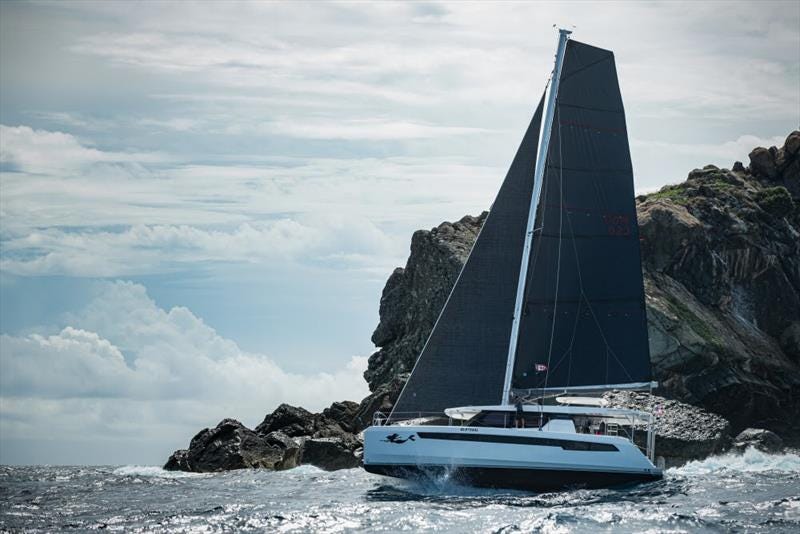
With the conclusion of the 2026 Caribbean racing season, the Caribbean Sailing Association’s Budget Marine Windies Multihull Trophy results are in. The Under 60 Feet Class once again produced close competition throughout the season. Georges Coutu's Leopard 50 La Novia successfully defended her title. Full results are at sail-world.com.

IN SHORT
New bullet
Cure Marine has unveiled the design of the upcoming Cure 68 GT, the first model to be launched since its merger with the McConaghy shipyard.
Double tri
Whilst Neel Trimaran and Rapido have long been the only players in this segment, two new cruising trimarans have been announced just a few days apart. Even more surprisingly, they are both 53 feet long. The VMG 53 (VPLP, Chedal Anglay, Thorne Design), is due in January 2027, whilst the Well 53, designed and built in France, is due at a date yet to be confirmed. More information will follow after the Cannes Boat Show.
Different
Vision Yachts is organising its first European Showcase in Port Ginesta from 28 to 30 August, with four Vision 444s available for trial. These are not brand-new show boats straight from the factory, but owners’ boats with tens of thousands of nautical miles under their belts and just as much experience to share.
Interesting
Recreational boating (< 24m) accounts for around 0.4% of EU transport GHG Emissions.
Setback
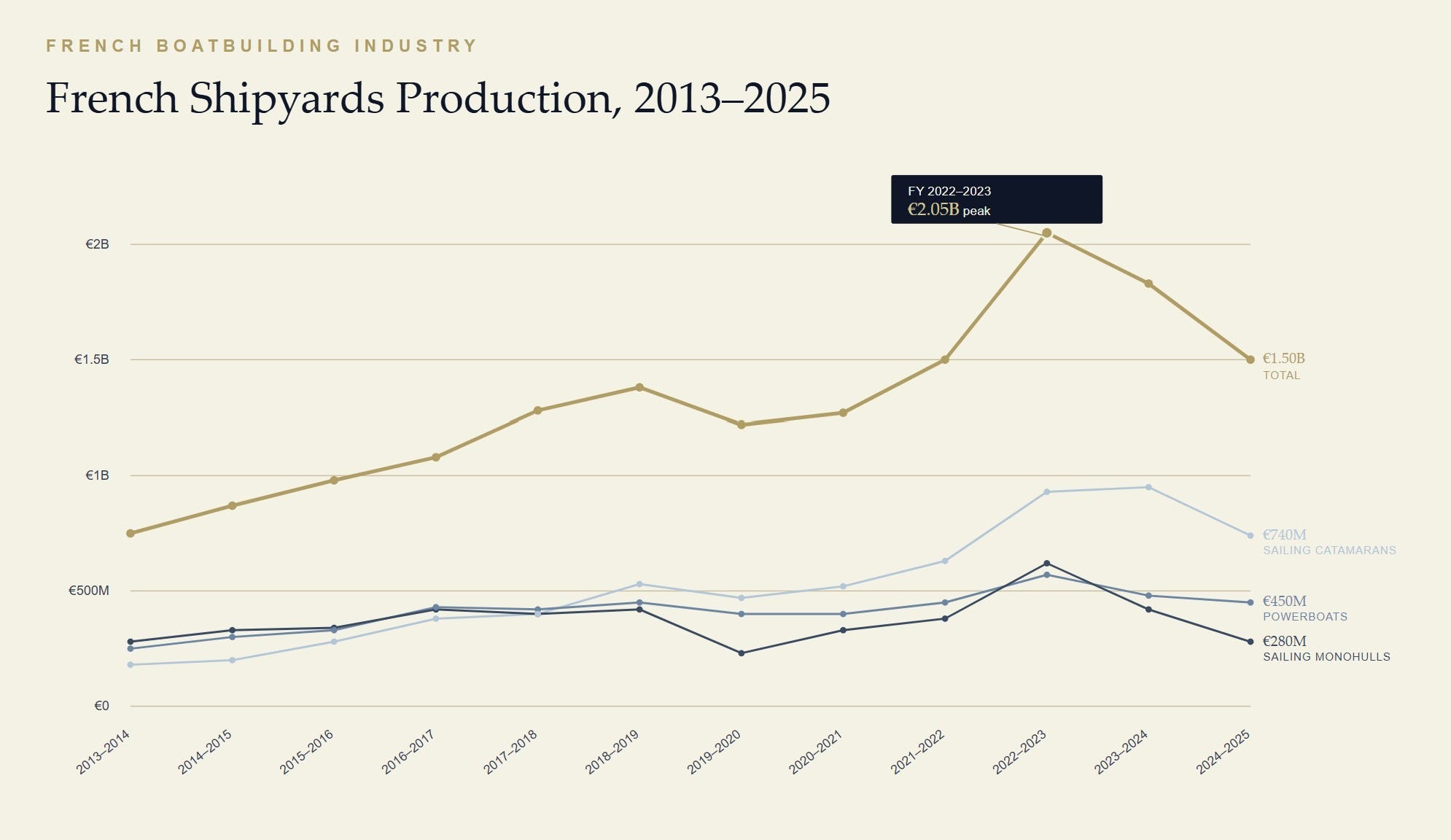
In 2025, the French marine industry as a whole generated a turnover of €5.4 billion By way of comparison, this represents 2 per cent of Volkswagen’s turnover, or just 18 per cent of Toyota’s net profit. For the second time only since 2013, when we began tracking this data, turnover from the production of sailing catamarans has fallen by 18 per cent. (Source: FIN)
EU-US
The EU and the US have finalised a trade agreement that reduces European customs duties on pleasure craft and components imported from the US to 0%, whilst European exporters to the US benefit from a tariff cap of 15%. It should be noted that the agreement expires automatically at the end of 2029. (Source: EBI)
VAT
The European Commission has published a practical guide on the customs and VAT treatment of pleasure craft. Key points to note: a boat used within the EU is presumed to have EU property status. Furthermore, the owner’s nationality, the country of registration or the flag do not in themselves determine the boat’s customs status. But this guide is not legally binding and its application may vary between Member States. (Source: EBI)
Big
The VELA Transport cargo trimaran has taken delivery of its two 50-metre carbon masts, manufactured by Lorima after 10,000 hours of work. Incidence Sails has just completed the 600 m² mainsail. Made from DFI, it weighs 786 kg. The cargo ship is scheduled to enter service early 2027.
RIP
Groupe Beneteau announced the passing of Dieter Gust on Wednesday, July 8. Founder of Construction Navale Bordeaux (CNB) in 1987 alongside Olivier Lafourcade, Dieter Gust left a lasting mark on the history of shipbuilding. A great sailor, visionary entrepreneur and hands-on leader, he was one of the notable figures in the boating world. Among his most significant achievements, he notably played a decisive role in the development of Lagoon multihulls.
Breaking
This really is a revolution! La Solitaire du Figaro, which for 50 years has been a breeding ground for French offshore racing and has produced all the great champions in the current IMOCA and Ultim classes, is moving away from monohulls (the Figaro Bénéteau 3, 9.75m/32ft) to trimarans. From the 2028 edition onwards, the Ocean Fifty class will take centre stage, confirming the dynamism and appeal of multihulls in general and this class in particular.
Rhum
Thirty-one multihulls, divided into three categories, are set to take part (Saint-Malo on 1 November) in the next Route du Rhum Destination Guadeloupe: Ultims (7), Ocean Fifty (11) and Vintage Multi (13).
World
A second edition of the solo round-the-world race in the Ultim class has been announced. The Arkéa Ultim Challenge Brest will set sail on 1 January 2028. Eight, or possibly nine, giant trimarans could take part with, for the first time, a woman – Alexia Barrier – at the helm of Francis Joyon’s former boat.
Wow
We’ve found the most appealing second-hand multihull currently on the market. A 65-foot catamaran designed by Nigel Irens. GT65 is for sale at Tan Orient in Dubai. It may not be the most spacious, but in terms of aesthetics (that Nigel Irens touch!) and the feel of sailing, there can’t be many better.
Follow-Up
Following the voluntary liquidation of Schionning Design International, Robert Quinn will continue to support the Schionning community and brand by offering his support to the existing and new builds.
Top Speed
If its unusual appearance had you wondering about its performance, rest assured: the MODX 70 #01 reached 23 knots in winds of 25 to 30 knots between Sardinia and Naples last May.
Wood
She’s beautiful, she’s made of wood, and she’s fast (20 knots) right from its very first sailing tests.. This is the eco-designed Outre-Loire foiling catamaran, designed and built in partnership with IMOCA skipper Armel Tripon.
Show
The International Multihull Show has just published the results for the 2026 edition. With 82 multihulls (63 sail and 19 power), this is a record-breaking edition in terms of number of vessels on display. With 51 per cent of visitors coming from abroad, the show reaffirms its rare international standing. Although visitor numbers have not been disclosed, 95 per cent of the 176 exhibitors say they intend to return next year. The show will take place from 21 to 25 April 2027.
Numbers
Lagoon Catamarans is said to have produced more than 7,700 multihulls since its foundation in 1984. Whilst production of the early models barely reached 50 units each, the best-seller is the latest Lagoon 42, with more than 1,140 catamarans produced. The Lagoon 380 has been produced in a run of 894 units. The top-of-the-range models (SIXTY, SEVENTY and EIGHTY) have already seen 136 launches, including both sailing and power versions.

Click the banner and pre-register for free.
MEDIA CENTRE
The 50 knot problem - Yachting World
Is 50 knots still the magic number? Or will the latest launches go through sailing’s ‘sound barrier’ for mile after mile offshore?
Yacht Brokerage Market, Q1 2026 in Numbers - Uliana Tikhonova
Sailing Multihulls: Higher Volume, Softer Prices
Taking the Plunge - The Lagoon bloom - Patrick le Quément
An interesting insider’s account of the evolution of Lagoon design, by the former star car designer who made a late career switch to the nautical world alongside VPLP.
On 24 July, Fountaine Pajot will be celebrating its 50th anniversary – Sud-Ouest
A look back in pictures at half a century of history for a key player in the world of multihulls.
SailGP announces bold five year expansion plan - Yacht Racing Life - More teams, more events, and a bigger global audience?

This issue of MULTI.pedia has been sent to 1,927 subscribers.
Editor: François Trégouët
This newsletter is published by EI François TREGOUET - MULTI.media RUN
208 B rue Leconte De Lisle - 97480 SAINT-JOSEPH
RCS St Pierre N°420395857
© 2026 François TREGOUET & MULTI.media RUN